A kitchen table at evening covered with a fanned stack of blank statements, a highlighter, a calculator and a phone, with a hand mid-note.

    The curriculum

    Everything, open, before you pay for any of it.

    4 courses, 32 modules, 131 lessons and 32 worksheets. Every module title and every lesson title is on this page. The first lesson of each course opens without an account.

    Course 1

    The Occupancy Course

    Turn empty park pads into monthly rent from local tenants, using refurbished salvage motorhomes bought, moved and finished under a $7,500 all-in cap.
    Written in full10 modules9 hours$149
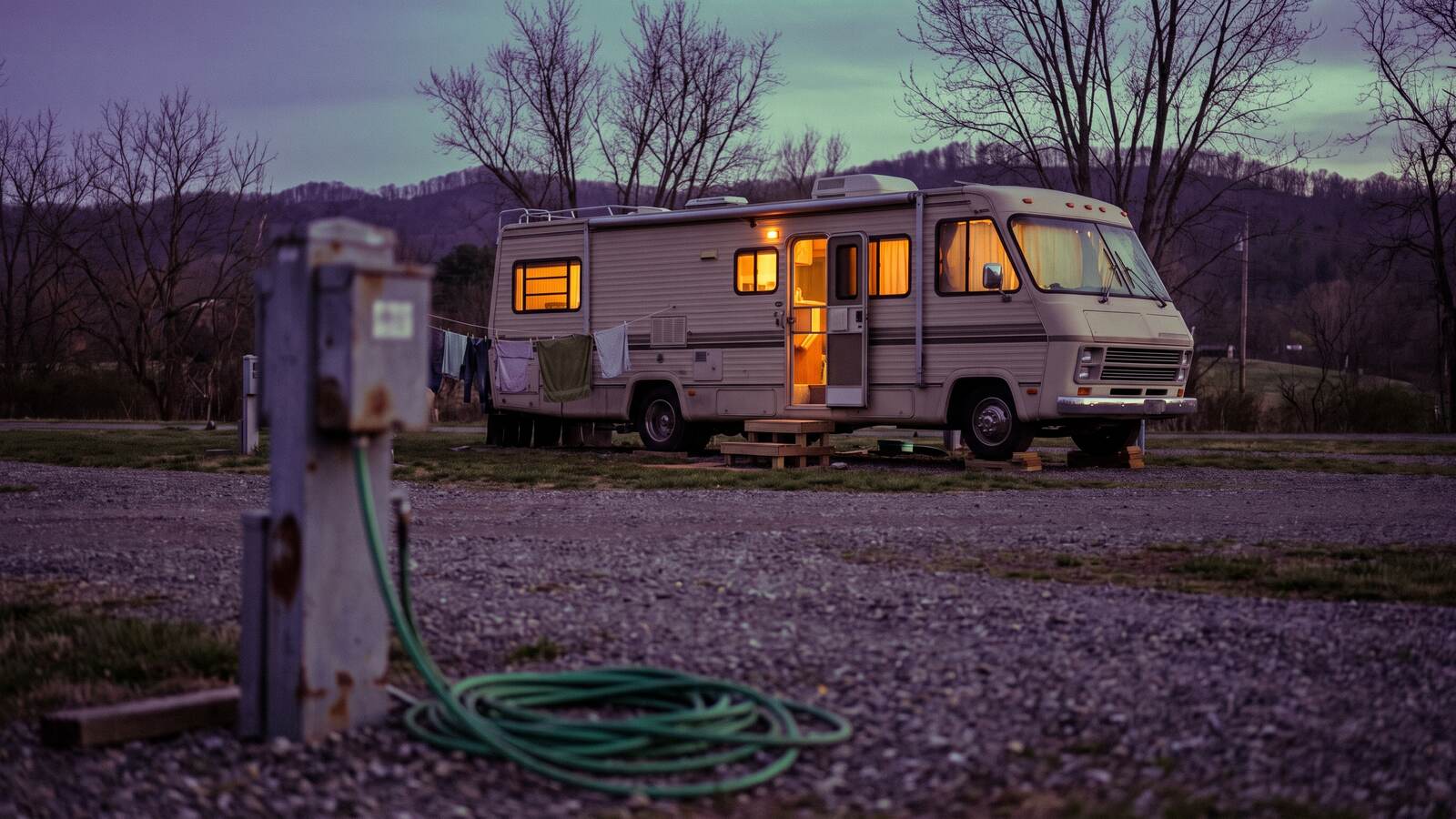
    A row of gravel pads in a small RV park at dusk, one older motorhome sitting level on blocks with warm light in its windows and a step at the door.
    01

    The Local-Tenant Thesis

    Why transient occupancy has a ceiling, why it collapses in winter, and who the local tenant actually is.

    • Why transient occupancy caps out
      The national RV park runs about two thirds full on a good year, and the reason is structural, not marketing.
    • The 28-night shift is already happening
      Long stays are the fastest-growing segment in the industry data, and they are the bridge from camping to tenancy.
    • Who the local tenant is
      A working adult who lives within twenty minutes of your gate and is priced out of every apartment in the county.
    • What you are really selling
      You are selling housing by the month, and once you accept that, every other decision in the park gets simpler.
    • Worksheet — Occupancy gap calculator
      Fill in the first three columns with your park's numbers.
    02

    Unit Economics

    What a pad rents for, what a mobile home really costs to place, the $7,500 unit, and payback in months.

    • What a pad rents for
      Long-term pad rent runs $350 to $700 rural and $1,200 and up metro; the unit lets you charge above the bare pad.
    • The mobile home comparison
      Placing a manufactured home costs $10,000 to $70,000 or more before you buy the home, which is the whole reason the salvage unit wins.
    • The $7,500 unit
      The cap covers purchase, transport, and refurb; it is a rule, not a target, and the split is the owner's number.
    • Payback in months
      Divide the cap by the monthly rent and you have the payback; at the cited rent ranges it is under two years everywhere and under a year in many markets.
    • Worksheet — Per-unit ROI sheet
      One unit, one column.
    03

    Sourcing Salvage Class A Units

    Where the units are, what the title types mean, which damage is cosmetic and which is fatal, and how to bid without blowing the cap.

    • Where the units are
      The two national salvage auctions list Class A motorhomes every week, and most buyers there are looking for something other than what you want.
    • Title types and what they mean for you
      A salvage or non-repairable title does not matter to a unit that will never drive again, but it matters to your state and your insurer.
    • Cosmetic versus fatal damage
      A dead engine is a discount; a wet ceiling is a rejection. Learn to tell them apart from the listing photographs.
    • Reading a listing end to end
      Year, length, layout, run-and-drive status, keys, and location all change the number you can bid.
    • Bidding under the cap
      Your maximum bid is arithmetic done before the sale, and the discipline is never going a dollar past it.
    • Worksheet — Auction bid sheet and inspection checklist
      One row per candidate unit.
    04

    Transport and Placement

    Getting a unit that does not drive from the auction yard onto your pad, level, connected, and secured.

    05

    The 30-Day Refurb

    A standard scope, a fixed calendar, and a budget tracker that stops the unit from going over the cap.

    • The scope that fits the cap
      Do the same list on every unit, do nothing that is not on the list, and the number stops surprising you.
    • Week one: strip, seal, and water-test
      Nothing goes into the unit until you are certain nothing is getting into the unit.
    • Weeks two and three: systems
      Power, gas, water, heat, and air, in that order, each one signed off before the next begins.
    • Week four: finish, punch, and photographs
      The visible work goes last, it goes fast when the systems are done, and it ends with a walk-through that decides whether the unit is ready.
    • Budget discipline and the tracker
      Every dollar goes on the tracker the day it is spent, and the tracker is compared to the bid sheet when the unit is done.
    • Worksheet — 30-day schedule and $7,500 budget tracker
      The first block is the calendar: one row per work item, in order, with the week it belongs to.
    06

    Permits, Zoning, Insurance

    The day-count that turns a guest into a tenant, how to screen your own state and county, and what to ask your insurance agent.

    • The 180-day line in Arizona
      Arizona has a statute written for exactly this situation, and the day it applies is a number you can count.
    • Check your state
      Four questions, asked of your state statute, your county code, and your attorney, before the first unit is bought.
    • County permits and the park license
      Your park's permit already allows occupied RVs on the pads; the job is to keep every unit inside what it allows.
    • Insurance
      A park-owned rental unit is not covered by the policy you have; the cost of the policy you need is a number only your agent can give you.
    • Worksheet — Jurisdiction screening checklist
      Answer every question for your state and your county before the first unit is bought.
    07

    Lease and Tenancy Structure

    Pad lease, unit rental, or rent-to-own; deposits; utility billing; and the documents your attorney reviews before you use them.

    • Three structures: pad lease, unit rental, rent-to-own
      You can rent the pad, rent the pad and the unit, or sell the unit over time; each changes who owns what and who is responsible for what.
    • Deposits and fees
      Collect what your state allows, hold it the way your state requires, and return it on the day your state says.
    • Utility billing
      Electricity is the cost that swings with the tenant, and how you bill it decides whether the unit's margin survives the summer.
    • The documents
      A lease, park rules, a move-in inspection form, a utility addendum, and a renters insurance requirement, each reviewed by your attorney before it is signed.
    • Worksheet — Lease outline
      A section-by-section outline of the unit rental lease and its attachments.
    08

    Finding and Screening Local Tenants

    Where local demand lives, how to write the ad, how to screen fairly and firmly, and how to run the showing and the move-in.

    • Where local demand lives
      The tenant is already within twenty minutes of your gate; the job is to be visible where they are already looking.
    • Writing the ad
      Say what it is, what it costs, and what is included, in that order, with photographs that show a home.
    • Screening
      Screen every applicant the same way, on income, history, and references, under the fair housing rules your attorney confirms apply to you.
    • The showing and the move-in
      Show a finished unit, sign a complete file, and walk the tenant through the systems before they sleep there.
    • Worksheet — Ad copy template and screening script
      The first block is the rental ad, line by line, with the blank you fill from your own unit.
    09

    Operations and Collections

    Rent day, the maintenance cadence that keeps a unit dry, the collections ladder, and the records that prove all of it.

    • Rent day
      One due date, one payment method, one statement, and a late fee that starts on the day the lease says.
    • The maintenance cadence
      A monthly walk, a seasonal seal check, and a funded reserve keep the unit from becoming the rot Module 10 warns about.
    • The collections ladder
      A fixed sequence of contacts and notices, on fixed days, ending in the process your statute requires and never in a padlock.
    • Records and reporting
      One file per unit, one file per tenant, one ledger for the park, and a monthly page that tells you whether the model is working.
    • Worksheet — Monthly operations checklist
      One sheet per month, done on the same day every month.
    10

    What Kills the Deal

    County bans, unit rot, the tenant who removes the unit, eviction timelines, rent-to-own traps, and over-improvement. Score each one before you buy.

    • County bans
      The county can say no, before or after you have placed units, and the only defense is to have asked first and in writing.
    • Unit rot
      Water is the only thing that destroys a unit, and it does it slowly, from the roof down, while nobody is looking.
    • The tenant removes the unit
      A unit on wheels can be towed by anyone with a truck, and the lease clause, the title, and the setup are what make it yours in fact and not only on paper.
    • Eviction timelines
      An eviction takes as long as your statute and your court say it takes, and the model has to survive that many months of zero rent on that pad.
    • Rent-to-own traps and over-improvement
      The two ways owners talk themselves out of the model's simplicity: selling the unit slowly, and building around it.
    • Worksheet — Deal-killer scorecard
      Score each risk 1 (low) to 5 (high) before the first unit and once a year after.

    Course 2

    The Fixed Costs Course

    Find every recurring charge a household pays, work out what each one is actually priced on, and lower the ones that move — without cutting the cover you needed.

    Written in full8 modules5 hours$129
    A kitchen table at evening covered with a fanned stack of blank statements, a highlighter, a calculator and a phone, with a hand mid-note.
    01

    The Standing-Order Audit

    Find every recurring charge you have, including the ones that no longer appear on a statement you read, and put them on one page in order of size.

    • The bills you cannot name
      Most households can name six recurring charges and are paying between fourteen and thirty. The gap is the whole opportunity.
    • Reading twelve months, not one
      Annual and irregular charges are invisible to a one-month review, and they are usually the largest discretionary lines you have.
    • The charges that never touch a bank statement
      Phone-billed services, app-store subscriptions and payroll deductions sit outside the statement and outside most people's mental total.
    • The one page
      One row per charge, sorted largest first, with the four columns that the rest of the course fills in.
    • Worksheet — The standing-order register
      One row per recurring charge.
    02

    What Each Bill Is Actually Priced On

    Every recurring charge is priced on one of five things. Knowing which one turns a vague 'it is too expensive' into a specific, answerable question.

    • The five pricing bases
      Usage, capacity, risk, access, or nothing at all. Each one is reduced by a completely different move, and using the wrong move wastes the call.
    • Usage-billed: power, water, gas, fuel, data
      You are billed for a quantity, so the only two levers are the unit rate and the quantity, and they are pulled in different places.
    • Risk-billed: every kind of insurance
      The premium is a function of the risk you present and the deductible you accept, so the lever is your own file, not the salesperson.
    • Access-billed, and the ones priced on nothing
      Subscriptions, memberships and fees priced purely on what the market will bear are the softest lines on the page, and they are soft in both directions.
    • Worksheet — Pricing-basis classifier
      Copy the charge names from Module 1's register into column one, then classify.
    03

    The Tier That Is Never Offered

    Most large recurring vendors publish a cheaper tier that existing customers are never moved onto. Finding it is research, not negotiation.

    • Why the cheaper tier exists and who it is for
      Acquisition pricing and retention pricing are different products sold at different prices, and you are on neither by default.
    • Finding it in writing
      The tariff, the rate card, the plan comparison page and the regulatory filing are all public, and one of them names your cheaper tier.
    • Lifeline, hardship and income-qualified tiers
      Utilities, telecoms and insurers run legally-mandated or voluntary low-income programmes that are almost never mentioned on an inbound call.
    • The annual price walk
      A charge that rises quietly every twelve months is a policy, not an accident, and the record of it is your strongest single argument.
    • Worksheet — Published-tier finder
      One row per vendor from your register.
    04

    The Call

    A scripted, twelve-minute phone call that gets a bill lowered, including the exact sentence that moves you to the department that can do it.

    • Who you are actually talking to
      The first person who answers is measured on call time and has a discount ceiling; retentions is measured on saves and has a different one.
    • The script
      Six sentences: what you have, what it costs, what is published, what you want, what you will do otherwise, and silence.
    • What you will do otherwise
      The only leverage a household has is the ability to actually leave, and it only counts if you have already checked that you can.
    • Getting it in writing and diarising the reversal
      A promotional rate that nobody diarises reverts, and the reversal is how a household ends up back where it started in eighteen months.
    • Worksheet — Call sheet and outcome log
      Print one per vendor.
    05

    Insurance Without Becoming Underinsured

    The one category where cutting the number can destroy you. How to lower a premium by changing an input rather than by removing cover.

    • What you are actually buying
      A policy is a list of named perils, a limit, a deductible and a set of exclusions, and only two of the four are yours to move.
    • The deductible lever
      Raising a deductible lowers a premium immediately, and it is only safe if the money is actually sitting somewhere you can reach.
    • Correcting your own file
      Insurers price on facts they hold about you, and some of those facts are wrong, stale or missing a discount you already qualify for.
    • When not to cut
      Liability limits, replacement-cost cover and the flood or earthquake question are the three places where saving the premium is the expensive choice.
    • Worksheet — Policy comparison sheet
      One column per policy or per quote.
    06

    The Energy and Water Audit

    The quantity half of every usage-billed charge, done with a $30 meter, a flashlight and one Saturday.

    • Find the biggest load first
      A handful of appliances account for most of a household's power, and measuring beats guessing every single time.
    • The running toilet and the leak
      A large water bill is almost never behaviour; it is a leak, and the meter tells you within twenty minutes whether you have one.
    • Envelope before equipment
      Air sealing and insulation return more per dollar than replacing a working furnace, and almost nobody does them in that order.
    • The rebate that pays for it
      Utilities and states publish rebate schedules that routinely cover a third to all of the work, and they are claimed before the job, not after.
    • Worksheet — Load and leak audit
      Top half: every plug load you measured, ranked by annual cost.
    07

    Contracts, Renewals and the Calendar

    Auto-renewal is the mechanism that undoes every saving in this course. The fix is a calendar, and it takes forty minutes to build once.

    • The auto-renewal machine
      Notice windows, rollover terms and evergreen clauses are designed around the fact that nobody diarises a date twelve months out.
    • Building the renewal calendar
      One recurring calendar, one entry per charge, each set for the day before the notice window opens, not the day it closes.
    • Cancelling cleanly
      In writing, to the address the agreement names, with a date and a reference, and keep the proof — because the charge that reappears is common.
    • The zombie charge
      A cancelled service that keeps billing is a dispute, not a negotiation, and the card network's rules are on your side if you act inside the window.
    • Worksheet — The twelve-month renewal calendar
      One row per charge.
    08

    What to Do With the Money

    A saving that is not moved somewhere on the day it appears is absorbed within two months. Where it goes, and in what order.

    • The absorption problem
      Money freed inside a current account does not stay freed; it becomes invisible spending inside two billing cycles.
    • The deductible fund comes first
      Module 5 raised your deductibles, which was only safe on the condition that the cash exists. This is where that condition is met.
    • The annual-lump trick
      Several of the charges you kept are cheaper paid annually, and the money you have freed is what lets you switch to annual billing.
    • The annual rerun
      This whole course is a ninety-minute job once a year, and the second run takes half as long because the register already exists.
    • Worksheet — Savings ledger
      One row per change you made.

    Course 3

    Keep It Running

    Diagnose before you buy a part. Seven modules on the appliances, heating, small engines and vehicle wear items a household already owns — and the exact line where an amateur stops and calls a licensed trade.

    Written in full7 modules6 hours$149
    Gloved hands reaching into the opened rear panel of an appliance, a row of screwdrivers laid out on a folded towel, a green work light overhead.
    01

    Diagnose Before You Buy a Part

    The single most expensive habit in home repair is buying the part the internet guessed at. A diagnosis is a measurement, and it costs nothing.

    • The parts cannon
      Replacing likely parts until the symptom goes away costs three to five times what the repair should, and often does not fix it.
    • The four tools and what each one answers
      A multimeter, a clamp meter, a non-contact tester and a phone camera answer nearly every household diagnostic question.
    • Splitting the machine into testable blocks
      Supply, sense, decide, act. Every household machine is that chain, and the fault is on one side of one boundary.
    • The line you do not cross
      Gas, sealed refrigerant, service-side electrical and defeated interlocks. What each one is, and who you call.
    • Worksheet — Diagnostic log
      One sheet per fault.
    02

    The Electricity You Can Measure Safely

    Enough electrical theory to take a reading that means something, and enough discipline to never take one you should not.

    03

    The Big Four Appliances

    Washer, dryer, dishwasher, refrigerator. The same five failure families account for most of what goes wrong with all four.

    • Water in, water out
      Fill valves, float switches, drain pumps and the check valve: the wet half of three of the four machines.
    • Heat and airflow
      A dryer that takes three cycles is almost never a broken heater; it is restricted airflow, and the vent is the first place to look.
    • The refrigerator you can fix, and the part you cannot
      Defrost systems, door seals, fans and drain lines are yours; the sealed system is not, and the symptoms differ.
    • Seals, bearings and noise
      Noise is diagnostic. Which noise, at which point in the cycle, names the part more reliably than any error code.
    • Worksheet — Appliance triage sheet
      Work the rows top to bottom.
    04

    Heat, Cooling, and the Line

    Filters, thermostats, condensate, coils and blower motors are yours. Gas trains and refrigerant are not. Knowing which is which saves both money and lungs.

    05

    Small Engines

    Mowers, generators, pressure washers, blowers. Four things make a small engine run, and nine times out of ten it is the fuel.

    • Fuel, spark, air, compression
      Four inputs, tested in that order, because the first one is the answer nine times out of ten.
    • The carburettor and stale fuel
      Ethanol-blended fuel left over a winter is the single largest cause of small-engine failure, and the fix is a bowl and a jet.
    • Storage that prevents the fault entirely
      Ten minutes in autumn removes the most common spring repair from your life permanently.
    • Generators and load
      Sizing, transfer, fuel duration and the two mistakes that kill people every storm season.
    • Worksheet — Small-engine service and lay-up card
      One card per machine, kept with the machine.
    06

    The Vehicle Wear Items

    The maintenance a shop charges the most margin on, done in a driveway with hand tools, and the jobs that are worth paying for.

    07

    Repair or Replace

    The arithmetic that decides, written down before you are emotionally invested in a machine you have already half disassembled.

    • The fifty-percent rule, and why it is usually wrong
      The rule of thumb ignores remaining service life, which is the variable that actually decides.
    • Parts availability as a signal
      When a control board is on back-order everywhere, the market is telling you the machine's service life is over.
    • The jobs worth paying for
      Some repairs are cheap in parts and expensive in consequences, and a professional's insurance is part of what you buy.
    • Keeping the record
      A machine with a written service history is worth more, fails less, and is far faster to diagnose the second time.
    • Worksheet — Repair-or-replace calculator
      Fill both columns before you order a part.

    Course 4

    Buying Used Without Getting Taken

    Where a used price actually comes from, how to read a listing, the forty-minute inspection, the paperwork that decides whether you own the thing, and the negotiation that happens before anybody says a number.

    Written in full7 modules5 hours$129
    A used-car lot at dusk under sodium lights, one person crouched at a front wheel shining a flashlight along the underside of a sedan.
    01

    Where the Price Actually Comes From

    An asking price is a position, not a value. Four forces set what a used item is really worth, and only one of them is the item's condition.

    • An asking price is a position
      The number in the listing was chosen for reasons that have nothing to do with the item, and knowing which reason is most of the negotiation.
    • Sold, not listed
      Completed-sale data exists in every category and is a different, smaller number than the asking prices you have been reading.
    • Condition versus evidence
      The market pays for documentation more reliably than for cosmetics, which is why an undocumented clean example is the better buy.
    • The all-in number
      Tax, title, transport, inspection, immediate deferred maintenance and the insurance delta belong in the price before you compare anything.
    • Worksheet — Comparables sheet
      Five completed sales, not five asking prices.
    02

    Reading a Listing

    What a listing says, what it carefully does not say, and the three questions that end a bad conversation in ninety seconds.

    • What is missing from the photographs
      The angle nobody shot is the angle with the problem in it, and it is the same handful of angles every time.
    • The language of avoidance
      'Runs great', 'needs nothing', 'selling for a friend', 'title in hand' — each phrase has a specific meaning worth knowing.
    • The three questions
      Asked by message before you drive anywhere, they end most bad deals in ninety seconds and cost nothing.
    • History reports and their limits
      A clean report is evidence of nothing much; the useful fields are the ones people never read.
    • Worksheet — Listing screen sheet
      One row per candidate.
    03

    The Forty-Minute Inspection

    A fixed sequence, done the same way every time, on a cold item, in daylight, with the seller standing where you can see them.

    • Cold, and in daylight
      Two conditions that a seller will resist and that reveal more than the rest of the inspection combined.
    • The walk-around
      Panel gaps, tyre wear, fluid colour, corrosion at the seams, and the smell test that finds water damage in ten seconds.
    • Under load
      Everything a machine hides at idle it reveals under load, and the load test is the half of the drive most buyers skip.
    • The professional inspection, and when it is mandatory
      A hundred and fifty dollars spent here is the highest-return money in the whole transaction, and there are three cases where it is not optional.
    • Worksheet — Forty-minute inspection sheet
      Print it, take it with you, and work down it in order in front of the seller.
    04

    Title, Liens and Paperwork

    The part that decides whether you own the thing. Everything here is state-specific and everything here is checkable before money moves.

    • Who actually owns it
      The name on the title, the name on the identification, and the person standing in front of you must be the same person.
    • Liens
      An undischarged lien follows the item, not the seller, and there is a defined way to buy a financed item safely.
    • Title brands and what they do to value
      Salvage, rebuilt, flood and lemon brands are permanent, and each one changes value, insurability and financing differently.
    • The bill of sale and the handover
      What the document must contain, what payment method protects you, and the sequence in which things change hands.
    • Worksheet — Paperwork checklist
      Every row is checked before money moves, in this order.
    05

    The Negotiation

    Most of it happens before anybody says a number. What you bring, what you say first, and the one thing that gives you all the power.

    06

    The Frauds

    Six patterns that account for most of what goes wrong, each with the one check that defeats it.

    • Curbstoning and title jumping
      An unlicensed dealer posing as a private seller, with a title never put in their name, and the item's history detached from it.
    • Odometer and hour-meter fraud
      Still common, still profitable, and still detectable from wear patterns and the paper trail in about five minutes.
    • Flood and structural repair
      Both are hidden deliberately, both leave signatures in the same six places, and both are permanent.
    • Escrow, shipping and payment scams
      The item that does not exist, the escrow service that is a website, and the payment that gets reversed after you deliver.
    • Worksheet — Fraud check card
      Six patterns, six checks.
    07

    The First Thirty Days

    What you do immediately after buying decides whether it was a good purchase. Baseline it, fix the deferred items, and start the record.

    • Baseline everything
      Fluids, filters, pressures, readings and photographs on day one, so that every future change has something to be compared against.
    • The deferred maintenance you already priced
      The list you negotiated with is the list you now execute, in the order the machine cares about.
    • Registration, insurance and the clock
      Most states run a short deadline for transfer, and missing it costs a penalty for the life of the ownership.
    • The record that pays you back
      The folder you start on day one is the evidence that Module 1 said the market pays for — and next time you are the seller.
    • Worksheet — First-thirty-days plan
      Dated tasks with a deadline column, because two of these have legal deadlines attached.